
How to Know When a Tree Needs Pruning vs. Full Removal
July 9, 2026 2:15 pmNot every tree problem calls for the same solution. Some trees need a careful trim to get back on track. Others have reached a point where removal is the only safe and practical option. Knowing the difference saves you money, protects your property, and helps you make the right call before a small problem becomes a costly one. Here is a straightforward guide to help homeowners figure out which direction makes sense.
What Is the Core Difference Between Pruning and Removal?
Pruning addresses specific branches or sections of a tree while keeping the tree standing and alive. It is used to remove dead or diseased wood, improve structure, manage growth, and reduce risk from overhanging limbs. Removal takes the entire tree down when it can no longer be saved, has become a safety hazard, or is causing damage to the surrounding property.
The goal of pruning is preservation. The goal of removal is resolution. Understanding which situation you are dealing with starts with looking at the tree honestly.
What Are the Signs That Pruning Is the Right Call?
Pruning is the right move when the tree is fundamentally healthy but has specific problem areas that need attention. A few branches do not define the whole tree.
- Dead or crossing branches. Branches that have died off, are rubbing against each other, or are growing inward toward the center of the canopy are good candidates for removal through pruning. Left alone, crossing branches create wounds that invite disease and insects.
- Overgrowth near structures. When branches extend over a roof, grow close to power lines, or press against a fence, pruning pulls them back before they cause damage. This is one of the most common reasons homeowners in Metairie and Gretna schedule tree pruning services each year.
- Uneven or heavy canopy. A canopy that has grown lopsided puts uneven weight on the trunk and root system. Selective pruning redistributes that load and reduces wind resistance, which matters significantly during storm season in the Greater New Orleans area.
- Early signs of disease or insect activity. When disease or insect damage is caught early and is limited to specific branches, pruning those sections out can stop the spread before it reaches the main trunk. This is why regular inspections matter. Waiting too long turns a pruning situation into a removal situation.
- Young trees being shaped. Structural pruning on younger trees is one of the best investments a property owner can make. Correcting poor branch angles and removing competing leaders early sets the tree up for a stronger, safer structure as it matures.
When Does a Tree Cross the Line Into Removal Territory?
Some trees reach a point where no amount of pruning will fix the underlying problem. Recognizing those signs early keeps your property and the people on it safe.
- More than 50 percent of the tree is dead or damaged. This is a general benchmark used by arborists. When the majority of a tree’s canopy is gone or compromised, the tree lacks the resources to recover. Pruning what remains puts more stress on an already weakened structure.
- The trunk is hollow or severely decayed. A tree with significant internal decay may look stable from the outside while the core that holds it upright is compromised. Soft spots, visible cavities, or fungal growth at the base of the trunk are warning signs that the structural integrity is gone.
- The tree is leaning and the lean is new. Trees that have always had a natural lean are usually stable. A tree that has recently started leaning, especially after a storm or heavy rain, often signals root failure or soil heaving. This is an urgent situation that warrants a professional assessment right away.
- Root damage or soil heaving. Raised or cracked soil around the base of a tree can mean the root system has been disrupted. Roots that have been cut during construction, damaged by disease, or weakened by saturated ground in areas like Algiers or Lakeview may no longer anchor the tree reliably.
- The tree is dead. A fully dead tree has no path to recovery. It also becomes increasingly brittle and unpredictable over time. Dead trees should be removed promptly, not left standing until they come down on their own terms.
Our tree services team evaluates these factors as part of every assessment, looking at the whole tree rather than just the visible symptoms.
Are There Situations Where the Answer Is Not Clear?
Yes, and that is more common than most people expect. A tree with moderate decay in one section, significant storm damage on one side, or a disease that has spread but not fully taken over sits in uncertain territory.
In those cases, a professional arborist assessment is the only reliable way to get an honest answer. An arborist looks at the root system, trunk integrity, canopy health, and the tree’s position relative to structures and people. They weigh the cost of ongoing care against the risk of leaving the tree standing.
Cabling and bracing is one option that can extend the life of a structurally compromised tree that is otherwise healthy. Our additional tree services include cabling systems that support aging or storm-damaged trees and reduce the risk of limb or trunk failure. This is a practical middle ground when a tree has value, whether historic, aesthetic, or ecological, but needs structural support to stay safely in place.
Tree appraisal is another tool worth knowing about. If you are weighing the cost of treatment against removal, an appraisal gives you a documented value for the tree. That matters for insurance claims and helps put the financial decision in clearer perspective.
Does the Species of Tree Change the Decision?
It can, and this is one of the details that often gets overlooked.
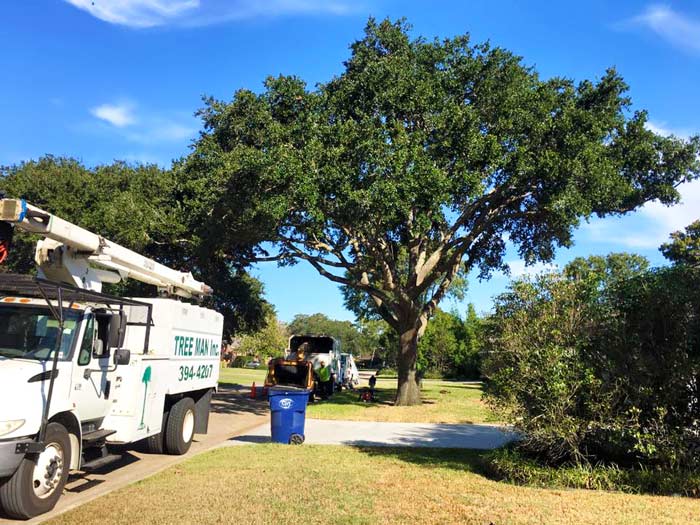
Some species are more prone to internal decay without visible external signs. Others compartmentalize disease well and can survive significant pruning without long-term damage. Live oaks, which are common throughout New Orleans and Jefferson Parish, are generally resilient and worth preserving whenever possible. They respond well to structural pruning and have deep cultural and ecological value in this region.
Palm trees are a different situation entirely. Their growth structure means traditional pruning rules do not apply the same way. Over-pruning palms, which is sometimes called hurricane cutting, actually weakens them and makes them more vulnerable to wind damage, not less.
Proper palm tree trimming removes dead fronds and fruiting bodies without stripping the canopy down to a point that stresses the tree.
Knowing the species you are working with changes what good care looks like, which is one reason working with a licensed arborist makes a real difference.
How Does Location on the Property Affect the Decision?
A tree’s position relative to your home, utilities, and neighbors plays a significant role in how urgently you need to act and what your options are.
A declining tree in an open area of the yard carries less immediate risk than the same tree positioned over a roof or near a gas line. Proximity to structures compresses the timeline on every decision. What might be a “monitor and prune” situation in an open yard becomes a “remove now” conversation when the tree is 10 feet from a bedroom window.
Trees growing near power lines in areas like Kenner or Metairie add another layer of complexity. Work near electrical infrastructure requires coordination and specific safety protocols. This is not a situation for unlicensed workers or DIY approaches. Our licensed arborist team carries the credentials and experience to work safely in these situations.
FAQ
Can a tree recover after heavy pruning?
Most healthy trees handle moderate pruning well and recover within one to two growing seasons. Removing more than 25 percent of a tree’s canopy at one time puts significant stress on it. A good arborist spaces major pruning work out over multiple seasons when deep cuts are needed.
How often should trees be pruned in New Orleans?
Most trees benefit from an inspection and light pruning every one to three years. Trees near structures, younger trees being shaped, or trees with known disease pressure may need more frequent attention. Palm trees generally need trimming once a year to remove dead fronds and manage fruiting bodies.
What does a leaning tree mean?
A tree that has always leaned with consistent root spread is usually stable. A tree that has recently developed a lean or shows soil disturbance at the base needs professional evaluation right away. Sudden leaning after storms or heavy rain is a warning sign that should not be ignored.
Is it worth saving an old tree or just removing it?
Historic and mature trees add real value to a property and are worth preserving when structurally sound. Cabling, bracing, and targeted pruning can extend the life of older trees significantly. The decision comes down to root and trunk integrity. If the core structure is still solid, preservation is usually worth the investment.
How do I know if a tree is dangerous?
Dead branches overhead, cracks in the main trunk, fungal growth at the base, visible root damage, and a new lean are the most reliable warning signs. If you notice any of these, scheduling a professional assessment is the right next step rather than waiting to see what happens.
Conclusion
Pruning and removal are not interchangeable. One preserves a tree that has a future. The other resolves a situation where keeping the tree standing creates more risk than removing it. Getting that distinction right protects your property, your investment, and the people around you.
At Tree Man Inc., we have been helping homeowners across New Orleans, Metairie, Gretna, and the Greater New Orleans area make these decisions since 1970. Call us at (504) 394-4207 for a free estimate and an honest assessment of what your tree actually needs.
Categorised in: Tree Service, Tree Trimming
This post was written by admin
Comments are closed here.